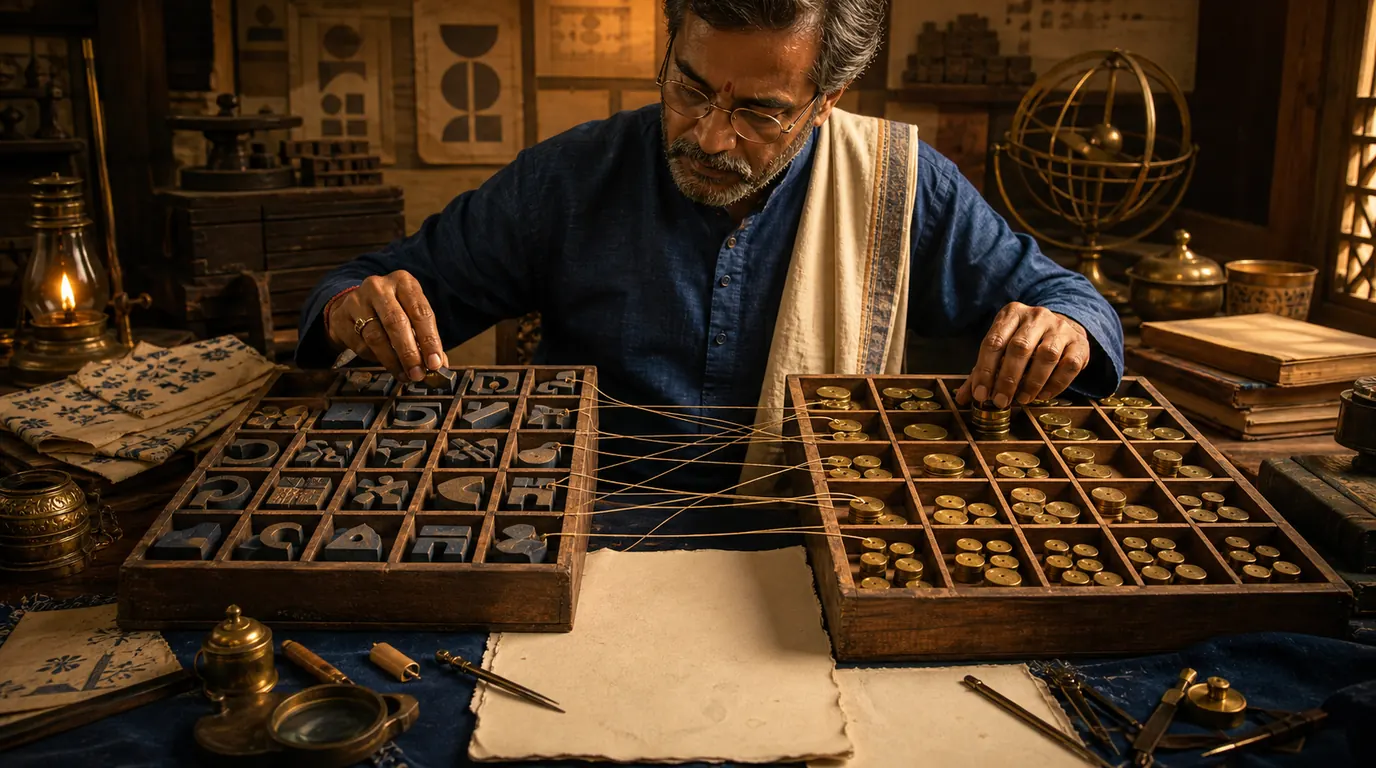
What the Chaldean table is, and where it comes from
The Chaldean numerology table assigns every letter of the alphabet a value from 1 to 8 — never 9 — and it groups letters by sound rather than by alphabetical order. That single design choice is what makes a Chaldean name number come out different from a Pythagorean one, often by several digits.
The name comes from Chaldea, the region of southern Mesopotamia (roughly today's southern Iraq) whose priests were famous in the ancient world for astronomy and omen-reading. The honest position on the history: no surviving Babylonian tablet contains this table in the Latin alphabet, because the Latin alphabet did not exist there. What we call "Chaldean numerology" today is a modern system, popularised in English in the early twentieth century by the astrologer Cheiro (the pen name of William John Warner), who presented it as descended from Chaldean sources. Whether that lineage is genuine or a Victorian-era attribution is contested and cannot be settled from the evidence we have.
The same caution applies to the rival system. Pythagorean numerology is named after the Greek mathematician Pythagoras, but its letter table in the form used now was set down by twentieth-century writers, not by anyone in the sixth century BCE.
So treat both tables as working conventions with long traditions behind them — useful for structured self-reflection, not as measurements of anything.
The full Chaldean letter table
Here is the table our calculators use, letter by letter:
| Number | Letters |
|---|---|
| 1 | A, I, J, Q, Y |
| 2 | B, K, R |
| 3 | C, G, L, S |
| 4 | D, M, T |
| 5 | E, H, N, X |
| 6 | U, V, W |
| 7 | O, Z |
| 8 | F, P |
| 9 | (no letters assigned) |
Notice that the groups are uneven. Number 1 carries five letters, number 7 carries only two. That is deliberate: the traditional claim is that letters were grouped by the sound they make and the "vibration" that sound was believed to carry, so alphabetical neatness was never the goal.
One thing you should know before you use any Chaldean chart you find online: minor variants circulate, usually over a handful of letters such as X, Y and W. Different lineages place them differently. The table above is the Cheiro-derived version that is standard in India, and it is the one behind our numerology alphabet chart. If a numerologist gives you a different value for one letter, they are probably not wrong, just working from a different lineage — ask which one.
Why 9 is missing from the Chaldean table
In the Chaldean tradition, 9 is held to be sacred, and sacred things are not handed out to ordinary letters. The number is associated with Mars (Mangal) in Indian practice and treated as complete in itself — the last of the single digits, the one every multiple of nine folds back into.
There is also a tidier mathematical reason the tradition points to: 9 behaves strangely in digit-sum arithmetic. Add 9 to any number and the digits of the result reduce back to the original. It absorbs rather than changes, which fits the idea of a number that stands outside the working set.
Here is the part people get wrong: 9 can absolutely appear as a Chaldean result. No letter is worth 9, but a total very often reduces to it. You will see exactly that in the second worked example below.
Calculating your Chaldean name number, step by step
- Write out the name you actually use, in Roman letters, in capitals.
- Replace each letter with its Chaldean value from the table above.
- Add the values of each word separately, then add the word totals together.
- Note the two-digit total before you reduce it. Chaldean tradition reads this "compound number" as meaningful in its own right.
- Reduce by adding the digits together until you reach a single digit — with one exception: 11, 22 and 33 are usually kept as they are, as master numbers. Our calculator preserves those three.
Worked example — ANJALI SHARMA:
- ANJALI: A(1) + N(5) + J(1) + A(1) + L(3) + I(1) = 12
- SHARMA: S(3) + H(5) + A(1) + R(2) + M(4) + A(1) = 16
- Total: 12 + 16 = 28 → 2 + 8 = 10 → 1 + 0 = 1
So the Chaldean name number is 1, ruled by the Sun, with 28 as the compound number sitting behind it.
If you type your name in Devanagari, our tools transliterate it to Roman letters first, then apply the table. That works, but be aware the spelling you choose changes the arithmetic — Anjali and Anjaly are different sums. Pick the spelling you genuinely sign and use, and stay consistent.
Chaldean vs Pythagorean, side by side
The Pythagorean table is simply the alphabet counted off in nines:
| Number | Letters |
|---|---|
| 1 | A, J, S |
| 2 | B, K, T |
| 3 | C, L, U |
| 4 | D, M, V |
| 5 | E, N, W |
| 6 | F, O, X |
| 7 | G, P, Y |
| 8 | H, Q, Z |
| 9 | I, R |
Run the same name through it:
- ANJALI: A(1) + N(5) + J(1) + A(1) + L(3) + I(9) = 20
- SHARMA: S(1) + H(8) + A(1) + R(9) + M(4) + A(1) = 24
- Total: 20 + 24 = 44 → 4 + 4 = 8
Same name. Chaldean says 1 (Sun). Pythagorean says 8 (Saturn). In Indian numerology those two are read as very different temperaments, and 8 is the number people are most anxious about. This is not a rounding error — it is what happens when I is worth 1 in one table and 9 in the other.
A second example, showing 9 arriving as a total:
- ROHIT MEHRA, Chaldean: 19 + 17 = 36 → 3 + 6 = 9
- ROHIT MEHRA, Pythagorean: 34 + 27 = 61 → 6 + 1 = 7
The Chaldean answer is 9 even though not one letter in the name is worth 9.
Compound numbers, and why Chaldean cares about them
Pythagorean practice usually reduces straight to a single digit and stops. Chaldean practice, following Cheiro, treats the unreduced two-digit total as carrying its own character — the single digit is the outer, public number, and the compound number is the inner one.
In that tradition, 28 (from ANJALI SHARMA above) is read as a number of promise undercut by misplaced trust — advancement that has to be rebuilt more than once. That is traditional interpretive lore recorded by one author roughly a century ago, not a finding, and you should hold it loosely.
Compound numbers are also where the two systems disagree most visibly. Cheiro reads 19 as one of the most fortunate compounds. Modern Western numerology counts 19 among the four "karmic debt" numbers, alongside 13, 14 and 16 — a burden rather than a blessing. Same number, opposite verdicts, and no way to arbitrate between them.
Which system Indian numerologists actually use
In India, Chaldean dominates for name work. Most practitioners you will meet in Mumbai or Delhi are working in a Cheiro-derived lineage, and name-correction consultants almost always score names on the Chaldean table.
Indian practice also attaches its own planetary rulers to the numbers: 1 Sun, 2 Moon, 3 Jupiter, 4 Rahu, 5 Mercury, 6 Venus, 7 Ketu, 8 Saturn, 9 Mars. The presence of Rahu and Ketu — the lunar nodes — at 4 and 7 is distinctly Indian. Western numerology assigns Uranus and Neptune to those positions. This is why a Western and an Indian numerologist can agree on your number and still describe it completely differently.
Pythagorean has not vanished here. It is common for birth-date work, which is where mulank (the day digit) and bhagyank (the full date) live — and those are unaffected by which letter table you use, because dates have no letters. A very common working split is Pythagorean or plain Vedic reduction for the date, Chaldean for the name. That is the split our numerology hub follows, and if you want the date side first, the Lo Shu Grid guide covers it.
When the two systems disagree, which do you follow
There is no test that settles it. Both tables are conventions, and the results differ because the conventions differ — nothing more.
What is reasonable to do:
- Pick one system and stay with it. Alternating until you get a number you like is how people talk themselves into expensive name changes.
- If you are in India and consulting a practitioner, use Chaldean — you will at least be speaking the same language they are.
- Give the date-based numbers more weight than the name-based ones. Your date of birth is fixed and unambiguous. Your name spelling is a choice, and every choice moves the number.
- Read the disagreement itself as information. A name that reads Sun-like in one table and Saturn-like in the other is telling you the letters are genuinely mixed, not that one table is lying.
And the honest limit: none of this predicts events. A name number does not decide your health, your court case, your marriage or your money, and nothing here is medical, legal or financial advice. Used well, a name number is a prompt for reflection — a way to ask whether the way you present yourself matches the way you actually work. Used badly, it becomes a reason to pay someone to add a second "e" to your surname.
If you want your own numbers without doing the addition by hand, run your name through the free Chaldean numerology calculator. It shows the compound total as well as the reduced digit, so you can see both layers. To compare the two systems on the same name, or to work out your Expression, Soul Urge and Personality numbers together, use the name numerology calculator — it takes just a name, no birth details required.
Frequently asked questions about the Chaldean numerology table
Why is there no letter assigned to 9?
The Chaldean table reserves 9 rather than cycling every ninth letter into that value. A final name total can still reduce to 9.
Do I reduce a compound number immediately?
Record the compound total first, then reduce it for the root number. Chaldean readers often interpret both, so discarding the compound number loses part of their method.
Can I mix Chaldean values with Pythagorean meanings?
That produces an undocumented hybrid. Use one table and its interpretation consistently, or show the two results side by side as separate systems.
Now try it on your own numbers
This guide explains the method. Open run your name through the Chaldean table to run it — the page shows its working, so you can check every step against what you have just read rather than taking the result on trust.