What a nakshatra is
A nakshatra is one of 27 equal segments of the zodiac, each 13°20' wide, marking where the Moon sits against the fixed stars. Twenty-seven segments times 13°20' gives exactly 360°.
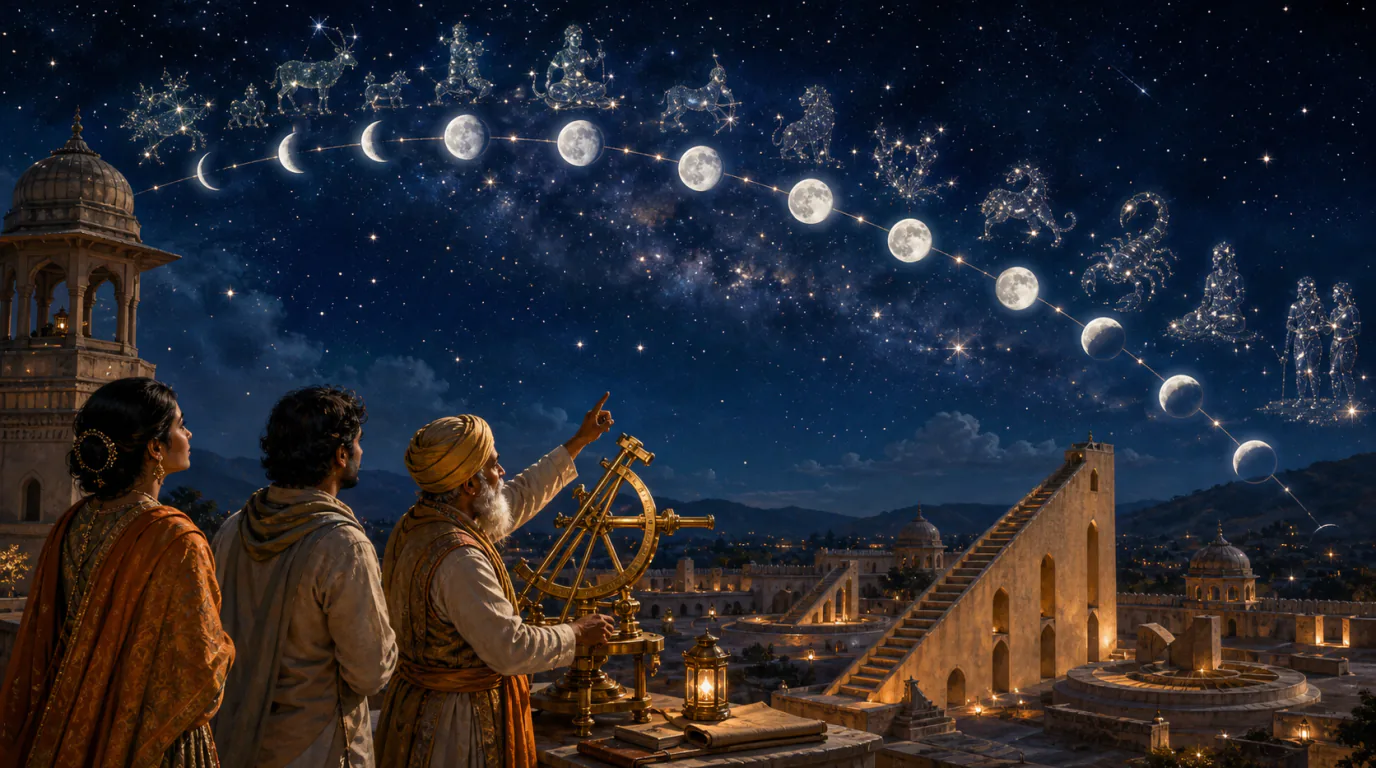
The number is not arbitrary. The Moon takes roughly 27.3 days to complete one circuit of the zodiac, so it crosses approximately one nakshatra per day. A nakshatra is, quite literally, a day in the Moon's journey — which is why the system is old, practical, and built around the Moon rather than the Sun.
Your birth nakshatra (also called janma nakshatra) is whichever segment the Moon occupied at the moment you were born. In Indian practice it is asked for more often than any other single chart detail, because it is the input to naming, matching and a great deal of timing work.
Nakshatras vs rashis — why both exist
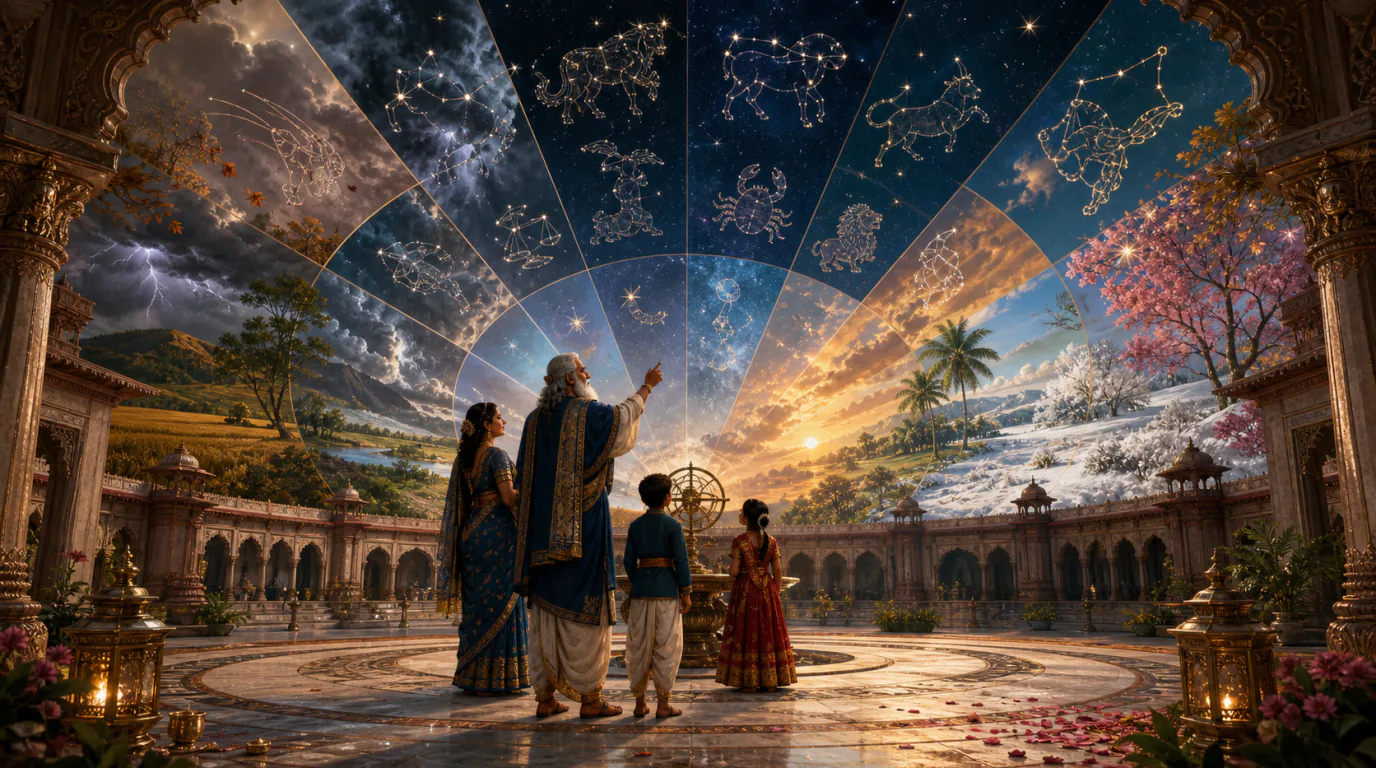
The same 360° is divided two ways. Twelve rashis of 30° each, and 27 nakshatras of 13°20' each. They do not line up: a nakshatra can straddle the boundary between two rashis.
The practical difference is resolution. Twelve categories put roughly one in twelve people in your group; 27 categories cut that to one in 27, and the pada subdivision below takes it to one in 108. When someone says Vedic astrology is more specific than sun-sign astrology, this is largely what they mean.
The interpretive difference is subject matter. Rashi is read for broad temperament; nakshatra is read for texture — motivation, instinct, the quality of your reactions. Neither replaces the other, and a competent reading uses both. Find yours with the free nakshatra calculator.
The four padas
Each nakshatra divides into four quarters called padas, of 3°20' each. Twenty-seven nakshatras times four padas gives 108 — the number behind mala beads, temple counts and a good deal else in Indian tradition.
Padas do real work. Each one maps to a navamsa (D9) sign, which is why the pada matters for marriage analysis. Each also carries an assigned syllable, which is the basis of naming a child by nakshatra and of reading rashi from a name.
Because a pada is only 3°20' wide, the Moon crosses one in about six hours. If your birth time is uncertain by more than an hour or two, your pada is uncertain — and anything built on it should be treated with matching caution.
The 27 nakshatras and their rulers
| # | Nakshatra | Span (sidereal) | Ruling planet | Deity | Gana | Traditional theme |
|---|---|---|---|---|---|---|
| 1 | Ashwini | Aries 0°00′ – Aries 13°20′ | Ketu | Ashwini Kumaras | Deva | Speed, healing, fresh starts |
| 2 | Bharani | Aries 13°20′ – Aries 26°40′ | Venus | Yama | Manushya | Endurance, restraint, transformation |
| 3 | Krittika | Aries 26°40′ – Taurus 10°00′ | Sun | Agni | Rakshasa | Sharpness, cutting through, purification |
| 4 | Rohini | Taurus 10°00′ – Taurus 23°20′ | Moon | Brahma | Manushya | Growth, beauty, material comfort |
| 5 | Mrigashira | Taurus 23°20′ – Gemini 6°40′ | Mars | Soma | Deva | Searching, curiosity, restlessness |
| 6 | Ardra | Gemini 6°40′ – Gemini 20°00′ | Rahu | Rudra | Manushya | Storm, upheaval, breakthrough |
| 7 | Punarvasu | Gemini 20°00′ – Cancer 3°20′ | Jupiter | Aditi | Deva | Return, renewal, safe harbour |
| 8 | Pushya | Cancer 3°20′ – Cancer 16°40′ | Saturn | Brihaspati | Deva | Nourishment, duty, steadiness |
| 9 | Ashlesha | Cancer 16°40′ – Cancer 30°00′ | Mercury | Nagas | Rakshasa | Insight, strategy, entanglement |
| 10 | Magha | Leo 0°00′ – Leo 13°20′ | Ketu | Pitris | Rakshasa | Ancestry, authority, legacy |
| 11 | Purva Phalguni | Leo 13°20′ – Leo 26°40′ | Venus | Bhaga | Manushya | Pleasure, rest, creativity |
| 12 | Uttara Phalguni | Leo 26°40′ – Virgo 10°00′ | Sun | Aryaman | Manushya | Contracts, service, reliability |
| 13 | Hasta | Virgo 10°00′ – Virgo 23°20′ | Moon | Savitar | Deva | Skill of the hands, craft, dexterity |
| 14 | Chitra | Virgo 23°20′ – Libra 6°40′ | Mars | Vishwakarma | Rakshasa | Design, brilliance, appearance |
| 15 | Swati | Libra 6°40′ – Libra 20°00′ | Rahu | Vayu | Deva | Independence, trade, flexibility |
| 16 | Vishakha | Libra 20°00′ – Scorpio 3°20′ | Jupiter | Indra-Agni | Rakshasa | Ambition, focus, goal-chasing |
| 17 | Anuradha | Scorpio 3°20′ – Scorpio 16°40′ | Saturn | Mitra | Deva | Friendship, devotion, cooperation |
| 18 | Jyeshtha | Scorpio 16°40′ – Scorpio 30°00′ | Mercury | Indra | Rakshasa | Seniority, protection, rivalry |
| 19 | Mula (Moola) | Sagittarius 0°00′ – Sagittarius 13°20′ | Ketu | Nirriti | Rakshasa | Roots, investigation, uprooting |
| 20 | Purva Ashadha | Sagittarius 13°20′ – Sagittarius 26°40′ | Venus | Apas | Manushya | Invigoration, persuasion, water |
| 21 | Uttara Ashadha | Sagittarius 26°40′ – Capricorn 10°00′ | Sun | Vishvedevas | Manushya | Lasting victory, integrity |
| 22 | Shravana | Capricorn 10°00′ – Capricorn 23°20′ | Moon | Vishnu | Deva | Listening, learning, tradition |
| 23 | Dhanishta | Capricorn 23°20′ – Aquarius 6°40′ | Mars | Vasus | Rakshasa | Rhythm, wealth, music |
| 24 | Shatabhisha | Aquarius 6°40′ – Aquarius 20°00′ | Rahu | Varuna | Rakshasa | Healing, secrecy, systems |
| 25 | Purva Bhadrapada | Aquarius 20°00′ – Pisces 3°20′ | Jupiter | Aja Ekapada | Manushya | Intensity, idealism, detachment |
| 26 | Uttara Bhadrapada | Pisces 3°20′ – Pisces 16°40′ | Saturn | Ahir Budhnya | Manushya | Depth, patience, wisdom |
| 27 | Revati | Pisces 16°40′ – Pisces 30°00′ | Mercury | Pushan | Deva | Completion, safe passage, kindness |
Each name opens that nakshatra’s own page: its four padas with their navamsa signs and name letters, its yoni and nadi for matching, and the next dates the Moon passes through it.
Read those themes as starting points for reflection, not as character verdicts. Every nakshatra has constructive and difficult expressions, and the classical texts describe both.
Why the ruling planet matters more than the theme
The ruler column is doing more work than the theme column, because nakshatra rulers drive the Vimshottari dasha system — the 120-year timing sequence that most Indian astrologers use to say when something is likely to be active.
Your birth nakshatra's ruler determines which planetary period you were born into and therefore the entire sequence that follows. Born in Rohini (Moon)? Your dasha sequence starts in a Moon period. Born in Bharani (Venus)? It starts in Venus. This single fact makes the birth nakshatra one of the highest-leverage details in the chart. See the Vimshottari dasha guide for how the sequence unfolds.
Where nakshatras are actually used
- Marriage matching. The 36-point ashtakoota system is computed almost entirely from the two birth nakshatras and moon signs — see how the 36 points are read.
- Naming a child. The pada's syllable traditionally dictates the first sound of the name.
- Daily timing. The nakshatra the Moon is transiting today is one of the five parts of Panchang.
- Tara Bala. The count from your birth nakshatra to today's gives a nine-fold favourability cycle used for choosing days.
- Muhurta. Specific nakshatras are traditionally preferred for specific activities — Rohini and Pushya for beginnings, Mula and Ashlesha generally avoided for auspicious work.
Gandanta and the junction points
One detail worth knowing because it causes unnecessary alarm. Gandanta is the junction where a water sign meets a fire sign — the last pada of Revati, Ashlesha and Jyeshtha, and the first pada of Ashwini, Magha and Mula. Births in these narrow windows are traditionally flagged as sensitive.
Two things to hold together. This is a real classical category, not a modern invention. And it is a small degree range described in cautionary language, not a diagnosis — a great many people are born in gandanta and live entirely ordinary lives. If a reading leads with gandanta and a large remedial fee, treat that as a commercial signal.
Honest limits
Nakshatra assignment depends on the ayanamsa — the offset between the sidereal and tropical zodiacs — and different schools use slightly different values. Lahiri is the Indian government standard and what we use; Raman and Krishnamurti differ by a fraction of a degree. Usually this changes nothing, but near a boundary it can move your nakshatra by one. If two calculators disagree, this is almost always why.
And the broader caution: this is a traditional interpretive framework, not a tested one. A nakshatra describes a category, and categories do not predict individuals.
Find your nakshatra
You need date, time and place of birth — the Moon moves too fast for a date alone to fix the pada. The free nakshatra calculator returns your nakshatra, pada, ruling planet and syllable, and the full birth chart puts it in context alongside your rashi and lagna.
Astrology here is a framework for reflection and planning — not medical, legal or financial advice.
Frequently asked questions about the 27 nakshatras
Are there 27 or 28 nakshatras?
Most birth-chart and Vimshottari dasha work uses 27 equal nakshatras. Some timing systems include Abhijit as a 28th station, but it is not inserted into the ordinary 27-part birth-nakshatra sequence.
Can a nakshatra cross two rashis?
Yes. Nine nakshatras cross a rashi boundary because 13 degrees 20 minutes does not divide neatly into 30-degree signs. The pada shows which side of the boundary contains the Moon.
Is a birth time needed to find my nakshatra?
A date and place can sometimes narrow it down, but the Moon can change nakshatra during a calendar day. An accurate time is needed near a transition and is essential when you also want the pada.