What is Ashtakoota matching?
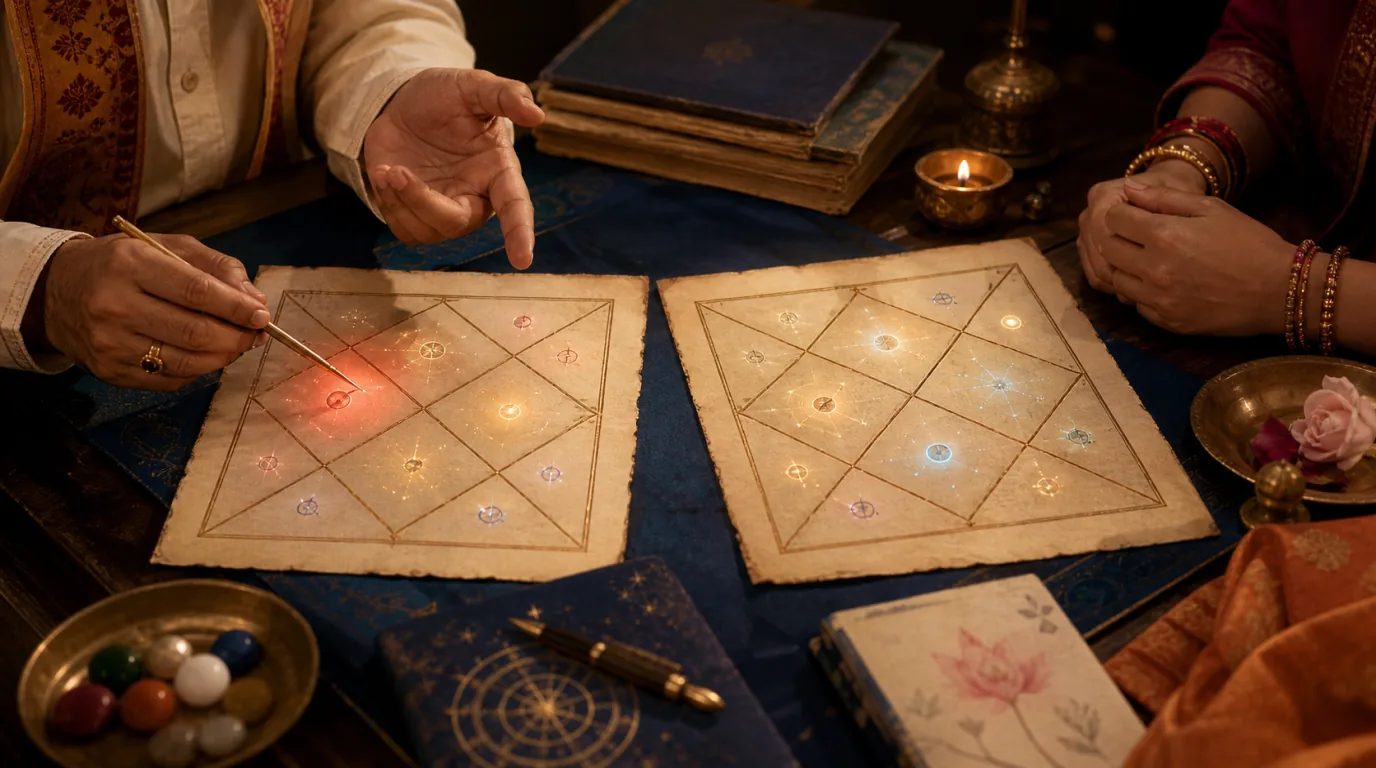
Ashtakoota Milan is a traditional Jyotish method that compares two people's birth Nakshatras and Moon signs across eight categories. Each category, or Koota, has a different maximum value. Together they add up to 36 points, which is why the result is often called Guna Milan or the 36-point match.
The method is commonly used as one part of marriage matching in North Indian practice. Other regions and lineages may use different matching systems, calculation tables or exception rules. Ashtakoota does not compare every planet in two birth charts, and the total is not a scientific measure of love, safety or the future of a relationship.
What information is used?
The calculation first finds each person's sidereal Moon sign and birth Nakshatra from their birth date, time and place. It then looks up the traditional relationship between those two placements for each Koota. This means correct birth details still matter, especially if the Moon changed Nakshatra close to the recorded birth time.
You can use the public Kundli matching calculator to see the eight component scores rather than only a total. For the underlying planetary positions, generate each person's Kundli.
The eight Kootas in plain language
1. Varna: maximum 1 point
Varna groups Moon signs into four traditional categories and compares their order. Older explanations may translate this directly as caste or spiritual rank. It should not be used to judge a person's worth, background or suitability. In the scoring system it is simply the smallest, one-point lookup.
2. Vashya: maximum 2 points
Vashya classifies signs using symbolic groups and compares how those groups are traditionally thought to relate. It is sometimes described with words such as influence, cooperation or attraction. A Vashya score does not show who will control a relationship and should never be used to excuse coercive behaviour.
3. Tara: maximum 3 points
Tara, also called Dina, counts the distance between the two birth Nakshatras in both directions and applies a nine-part cycle. Traditional readers connect the result with general support or wellbeing. It is a symbolic star-counting rule, not a health forecast.
4. Yoni: maximum 4 points
Yoni assigns an animal symbol to each Nakshatra and compares the pair through a traditional friendship table. It is often interpreted in terms of instinct, affection, temperament or physical comfort. The result cannot measure attraction, sexual consent or intimacy between real people.
5. Graha Maitri: maximum 5 points
Graha Maitri compares the planetary rulers of the two Moon signs using classical friendship and enmity relationships. It is commonly discussed as mental rapport or shared outlook. Actual communication depends on language, listening, values and behaviour, none of which a planetary lookup can test.
6. Gana: maximum 6 points
Gana places Nakshatras in Deva, Manushya or Rakshasa groups. These names are traditional archetypes, sometimes loosely described as gentle, human and forceful temperaments. Rakshasa Gana does not mean a person is bad or dangerous, and Deva Gana does not make someone morally superior.
7. Bhakoot: maximum 7 points
Bhakoot, or Rashi Koota, examines the numerical distance between the two Moon signs. Certain sign relationships receive fewer points under the standard table. Some schools then check additional conditions involving the Moon-sign rulers before deciding how much weight to give that result.
8. Nadi: maximum 8 points
Nadi sorts Nakshatras into three traditional categories and gives the largest share of the total. Matching categories can produce a zero in the standard calculation, often called Nadi Dosha. This is not a medical or genetic test. It cannot identify fertility issues, inherited conditions or the health of future children.
How the 36-point total should be read
A commonly quoted convention treats 18 points as a minimum and describes higher bands as more favourable. That is a custom, not a universal pass mark. Regional rules differ, and even within one method the same total can be made from very different component scores.
For example, imagine Couple A receives 25 out of 36, including zero for Nadi, while Couple B receives 25 with points spread more evenly across all eight categories. The headline number is identical, but a traditional reader would not describe the reports in exactly the same way. They would inspect which categories created the result and whether their school recognises any exception rules.
The reverse is also important. A score below a customary threshold does not prove that a relationship will fail. A high score does not prove that a relationship will be happy, respectful or lasting.
What people mean by cancellation rules
Some traditions apply Dosha cancellation or exception rules, especially for Nadi and Bhakoot. A reader may consider shared or friendly sign lords, different Nakshatra quarters, the exact Moon signs or other chart conditions. The rules are not identical across schools, so a calculator and a family astrologer can legitimately return different interpretations.
An exception rule does not change the original lookup; it changes how a particular tradition weighs it. A transparent report should show the base score, name the rule being applied and avoid presenting a disputed exception as an astronomical fact.
Why the full Kundlis may also be compared
Ashtakoota is mainly a Moon-and-Nakshatra comparison. A broader Jyotish consultation may also compare the ascendants, seventh houses and their rulers, Venus, Jupiter, Mars, Dashas and other chart patterns. Manglik checks are usually handled separately from the eight Koota score.
Looking at more chart factors can provide a more detailed traditional reading, but it does not turn astrology into certainty. Adding more symbols can also create contradictory signals. A responsible reader explains those conflicts instead of selecting only the factors that support a desired answer.
A practical way to use a matching report
- Verify both sets of birth details. Check spellings, dates, local times, places and timezones.
- Read all eight scores. Do not stop at the total or a colour-coded label.
- Ask which rules were used. Note the regional method and any Nadi or Bhakoot exception rather than assuming every calculator agrees.
- Separate symbolism from real evidence. Discuss values, communication, money, family expectations, children, work and location directly with each other.
- Make the decision yourselves. Use the report for reflection, not as permission or a veto imposed on either person.
What Ashtakoota cannot tell you
A 36-point score cannot assess consent, trust, conflict skills, financial honesty, emotional maturity or whether someone is safe. It cannot identify genetic conditions, fertility or sexually transmitted infections. Those questions require honest conversation and, where relevant, qualified medical, legal or counselling support.
Astrology is a symbolic tradition rather than a scientifically validated compatibility test. No score can decide whether two people should marry or stay together. If a report is being used to pressure, shame or frighten either partner, pause the process and return the decision to the people whose lives it affects.
Frequently asked questions
Is 18 out of 36 always enough for marriage?
No. Eighteen is a widely repeated customary threshold, not a guarantee or a rule followed in every tradition. The component scores and real-world relationship matter more than treating one number as automatic approval.
Does a low Nadi score mean a couple cannot have healthy children?
No. Nadi is a traditional category, not a biological examination. People with health or family-planning questions should use evidence-based medical screening and advice.
Can a high score make up for serious relationship problems?
No. A high Ashtakoota result does not cancel dishonesty, abuse, incompatibility in life goals or lack of consent. Personal safety and freely made decisions take priority over an astrological score.