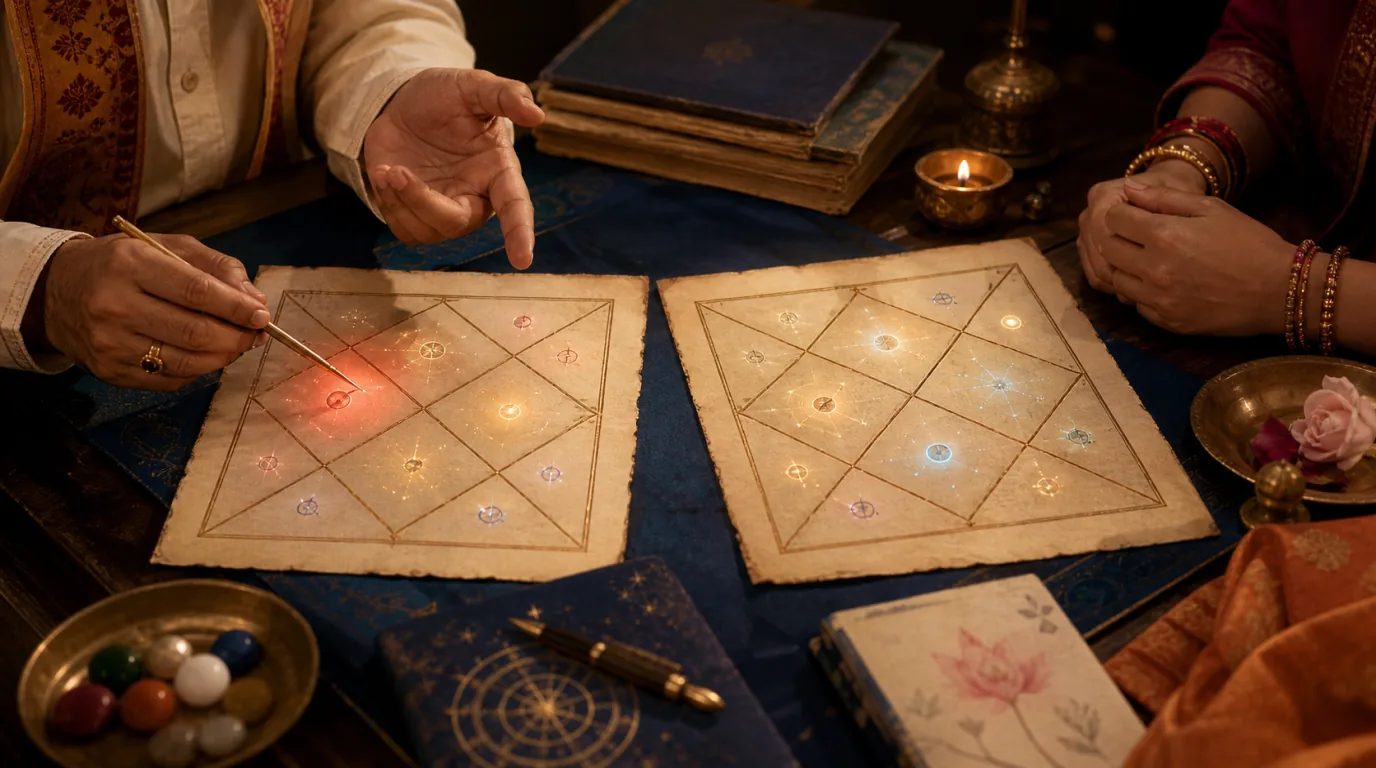
What manglik dosha is
Manglik dosha (also mangal dosha or kuja dosha) is the placement of Mars in the 1st, 2nd, 4th, 7th, 8th or 12th house of a birth chart. That is the entire definition. One planet, six houses.
The reasoning is that these houses touch marriage and domestic life — the 7th is marriage itself, the 8th its longevity, the 4th domestic peace, the 2nd family, the 12th the bedroom and private life. Mars signifies heat, force and conflict. Placed in those houses, tradition reads it as introducing friction into married life.
Two facts to hold on to from the start. Manglik dosha is not part of the 36-point gun milan score — it is a separate check, which is why a couple can score 30 gunas and still be flagged. And roughly a quarter to a third of all charts qualify, simply because six houses out of twelve is half the chart before other conditions are applied.
How it is calculated — and the three reference points
Here is where calculators quietly disagree. Mars can be counted from three different starting points:
- From the lagna (ascendant) — the standard and most widely used.
- From the Moon — used in many North Indian traditions as a second check.
- From Venus — the significator of marriage, used in some South Indian practice.
A chart can be manglik from one reference and not another. Strict practice requires the dosha from lagna and Moon before treating it as significant; looser practice flags any single occurrence. This is the main reason two websites give you opposite answers, and neither is making an arithmetic error.
Severity is also graded. Mars in the 7th or 8th is traditionally read as strongest, the 1st and 4th as moderate, the 2nd and 12th as mildest. Some traditions exclude the 2nd entirely.
The cancellation rules almost nobody shows you
This is the most important section, and it is the part free calculators routinely omit — they print "Manglik: Yes" and stop, which is where the fear comes from.
Classical texts list extensive bhanga (cancellation) conditions. The widely accepted ones:
- Both partners are manglik. The best known. The dosha is considered mutually neutralised.
- Mars in its own sign or exaltation — Mesha, Vrischika or Makara. A dignified Mars is not read as damaging.
- Mars in Simha or Kumbha in the relevant houses is excluded in many traditions.
- Mars aspected by or conjunct Jupiter, and in many readings the Moon. Jupiter's aspect is classically the strongest single mitigator.
- Age. Several traditions hold the dosha weakens substantially after roughly 28, when Mars is considered mature.
- Saturn's aspect on Mars, in some schools.
- Mars in a movable sign or in specific navamsa positions, per some regional rules.
Apply these honestly and the population of genuinely, seriously manglik charts shrinks dramatically. A reading that reports the dosha without checking a single cancellation has done a quarter of the job.
Where the fear comes from
The traditional claim attached to strong manglik dosha is severe — discord, separation, in the harshest older formulations harm to the spouse. That language is why the term causes real distress and real broken engagements in India today.
Some perspective is owed here. These formulations come from texts written for a very different social context, in which marriage was arranged early, women had little exit, and the astrologer's caution served a protective function. Reading that language literally into a modern marriage, with modern life expectancy and modern choice, is a category error.
And the empirical position should be stated plainly: there is no controlled evidence that Mars's house position affects marital outcomes. No study supports it. Marriages between manglik and non-manglik people succeed and fail at rates nobody has ever shown to differ.
What is documented is the harm of the belief itself — engagements broken, individuals stigmatised, families paying substantial sums for remedial rituals. If a practitioner leads with catastrophe and follows with a large fee, that is a commercial structure, not a diagnosis.
Remedies, and what to make of them
Traditional prescriptions include Hanuman worship (Mars's deity) on Tuesdays, red coral after proper chart analysis, Mangal mantra, fasting, and charity of red items and lentils.
Kumbh vivah — a symbolic marriage to a pot, tree or idol performed before the real one — is the best-known remedy and the one most worth thinking about. It is a ritual that transfers the supposed effect to the object. Whether you find that meaningful is a personal matter; what it is not is a medical or contractual necessity.
The behavioural reading of Mars is more useful than any of it: if your chart emphasises heat and impatience, then managing temper, giving conflicts room to cool, and not making irreversible decisions while angry is advice that stands on its own merits regardless of what you believe about the planet.
Check it properly
The free manglik dosha calculator checks Mars from lagna, Moon and Venus, grades severity, and applies the cancellation conditions rather than stopping at yes or no. You need date, time and place of birth, since house placement depends on an accurate time.
For the separate 36-point compatibility check, use gun milan or the full kundli matching — and read how many gunas actually matter before drawing conclusions from either.
Astrology here is a framework for reflection and planning — not medical, legal or financial advice, and no chart placement should decide whether two people marry.
Frequently asked questions about Manglik Dosha
Can Manglik Dosha be checked from the Moon and Venus too?
Some traditions repeat the house test from the Moon and Venus after checking Mars from Lagna. A calculator should state which reference points it uses instead of presenting one convention as universal.
Does one Manglik placement cancel a marriage?
No. Traditional matching also checks cancellation rules, the partner's chart, the 7th house and the wider relationship context. Consent, safety and communication matter more than a label.
Is Manglik Dosha part of the 36-guna score?
No. Ashtakoota and Manglik are separate calculations. A couple can have a high guna score and a Manglik flag, or a lower score with no Manglik placement.