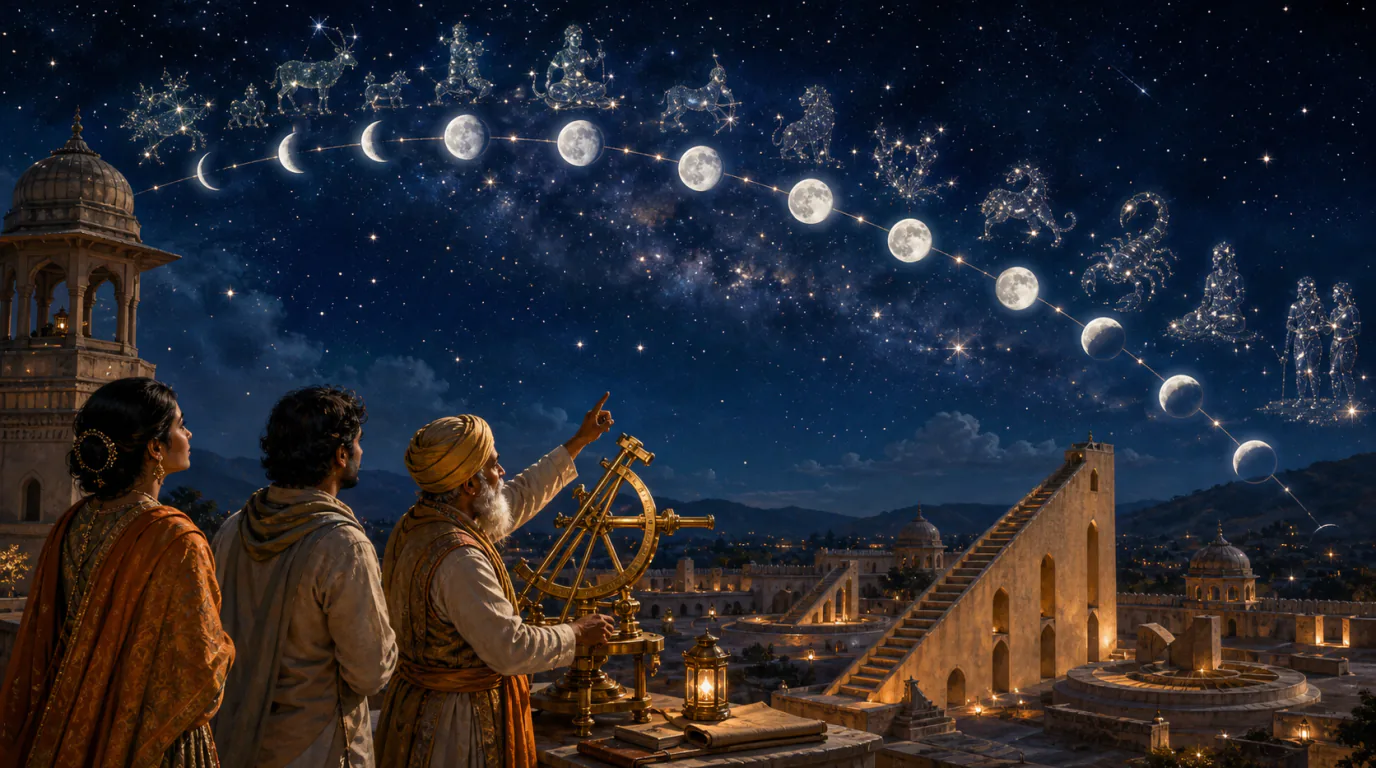
What a house is
A house, or bhava, is one of twelve divisions of the chart representing an area of life. Signs describe how a graha behaves; houses describe where in your life it shows up.
The count always starts from your lagna (ascendant) — the sign rising on the eastern horizon at your birth. That is the 1st house. The next sign is the 2nd, and so on around the chart. Because the lagna changes roughly every two hours, the houses are the most time-sensitive part of your chart and the reason birth time matters so much. The lagna guide covers this in detail.
The twelve bhavas
| House | Name | Covers |
|---|---|---|
| 1st | Tanu | Body, appearance, temperament, overall vitality, the self |
| 2nd | Dhana | Accumulated wealth, speech, food, immediate family |
| 3rd | Sahaja | Courage, effort, younger siblings, short travel, skills |
| 4th | Sukha | Home, mother, property, vehicles, inner peace |
| 5th | Putra | Children, intelligence, creativity, romance, past merit |
| 6th | Ripu | Illness, debt, enemies, competition, daily service |
| 7th | Kalatra | Marriage, partnership, business partners, the public |
| 8th | Ayu | Longevity, upheaval, inheritance, hidden things, research |
| 9th | Dharma | Fortune, father, teachers, belief, long journeys |
| 10th | Karma | Career, status, public role, action in the world |
| 11th | Labha | Gains, income, networks, elder siblings, fulfilled wishes |
| 12th | Vyaya | Loss, expenditure, foreign lands, solitude, sleep, release |
The groupings that do the real work
Individual house meanings are only the start. Analysis leans heavily on how the twelve group together.
Kendras (1, 4, 7, 10) — the angular houses, considered the pillars of the chart. Grahas here act with force and visibility.
Trikonas (1, 5, 9) — the trine houses, considered the most auspicious. They carry dharma, fortune and merit. A graha ruling both a kendra and a trikona becomes a powerful yogakaraka for that ascendant — the basis of much of raj yoga analysis.
Dusthanas (6, 8, 12) — the difficult houses: illness, upheaval, loss. Grahas here are traditionally read as strained.
Upachayas (3, 6, 10, 11) — the "growing" houses, which improve over time. This is the important counterweight to the dusthana idea: the 6th is both a dusthana and an upachaya, and malefics there are widely read as good — they give the capacity to outwork competition and beat illness. A strong 6th is an asset, not a curse.
That overlap is worth sitting with, because it is the clearest evidence that the "good house / bad house" framing is too crude to be useful on its own.
How houses are actually read
Three signals combine, and beginners usually stop at the first.
Occupancy — which grahas sit in the house. The most obvious signal and the least reliable alone, since most houses are empty in most charts.
Lordship — where the ruler of that house sits. This matters more than occupancy. If your 10th house is empty but its ruler sits strong in the 1st, career is still a live theme. An empty house is not an empty area of life.
Aspects — which grahas cast their drishti onto the house. Every graha aspects the 7th from itself; Mars, Jupiter and Saturn have additional special aspects. See the drishti guide.
A fourth signal, karaka, cuts across all of them: each house has a natural significator regardless of your chart — Jupiter for children and the 5th, Venus for marriage and the 7th, Saturn for longevity and the 8th. Reading a house without checking its karaka misses half the picture.
Why house systems disagree
This is the genuine technical controversy, and you should know which side your chart is on.
Whole sign houses — the entire rising sign is the 1st house, the next sign the 2nd, and so on. Every house is exactly 30°. This is the classical Indian standard and what we use.
Placidus, Koch and other quadrant systems — houses are unequal, calculated from the exact degree of the ascendant. Common in Western astrology and in some KP practice.
The practical consequence: a graha can land in the 9th house under one system and the 10th under another. That is not a rounding difference, it is a different reading. Quadrant systems also become unstable at high latitudes, where houses distort severely — which is one reason the whole-sign approach travels better.
If a Western astrologer's chart of you disagrees with an Indian one about house placements, this is usually the reason, and neither is making an arithmetic error.
Honest limits
Houses depend entirely on an accurate birth time. The lagna moves about one degree every four minutes; an hour's error commonly shifts every house by a whole sign and invalidates the entire house-based reading. If your birth time is a family estimate, treat house analysis as provisional and lean on the Moon-based techniques instead, which need only the date.
And the standing caveat: this is a traditional interpretive framework with no controlled evidence behind it. A house placement describes a theme to reflect on, not an event that must occur.
See your own houses
Generate your chart with the free kundli calculator — it places all nine grahas into the twelve bhavas from your birth details and shows the ruling planet of each house. Pair it with the navagraha guide to read what each placement means, and with the gochar guide to see how current transits move through them.
Astrology here is a framework for reflection and planning — not medical, legal or financial advice.
Frequently asked questions about the 12 houses
What does an empty house mean?
It does not mean that area of life is absent. Read the sign on the house, the house lord and the aspects reaching it. Most charts have several empty houses because nine grahas are spread across twelve places.
Which house represents career?
The 10th house is the main house of public work, status and duty. The 6th adds daily work and service, while the 2nd and 11th help describe income and gains.
Can the house change if my birth time is wrong?
Yes. Lagna and all twelve houses are time-sensitive. If the recorded time is uncertain, house-based conclusions should be treated as provisional until the time is checked.