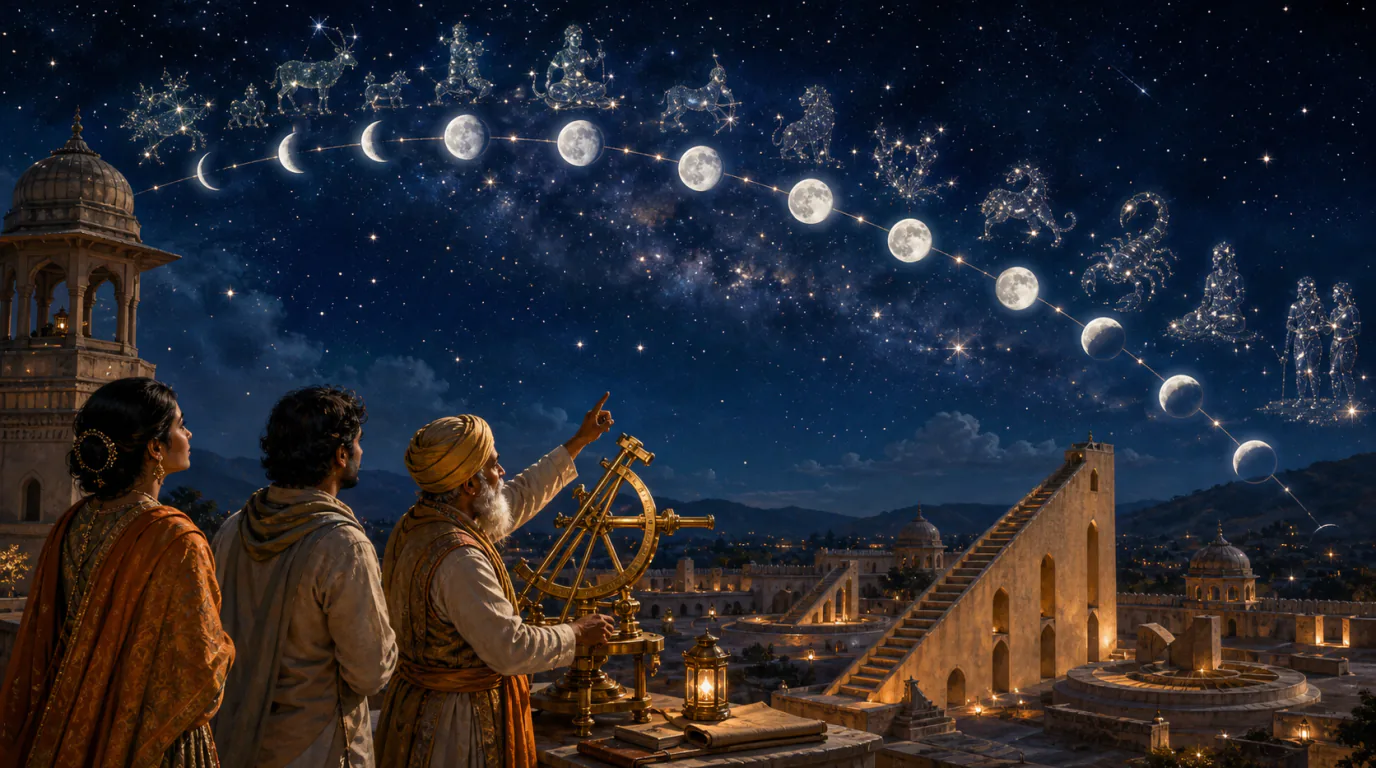
What a yoga is
A yoga is a named combination of planetary placements that classical texts describe as producing a particular result. The Sanskrit means "union" or "joining" — two or more chart factors coming together.
Jyotish has hundreds of them. They range from the structural and widely used to the obscure and rarely seen. Two families dominate popular conversation: raj yogas, concerning status, authority and recognition, and dhana yogas, concerning wealth.
Before the details, the single most useful fact about yogas: almost every chart contains some. With nine grahas across twelve houses and hundreds of named combinations, finding a few is close to statistically guaranteed. Anyone announcing that you have a raj yoga has told you something true and almost meaningless without the rest of the analysis.
How a raj yoga forms
The core definition is precise. A raj yoga forms when the ruler of a kendra (house 1, 4, 7 or 10) and the ruler of a trikona (house 1, 5 or 9) come into relationship — by conjunction, mutual aspect, or exchange of signs.
The logic behind it: kendras are the pillars of the chart, the houses of visible action; trikonas carry fortune and merit. Capability joined to fortune is the classical recipe for elevation.
Some ascendants get a shortcut. When one graha happens to rule both a kendra and a trikona, it becomes a yogakaraka — a single planet carrying the whole combination. Saturn is yogakaraka for Vrishabha and Tula ascendants; Mars for Karka and Simha; Venus for Makara and Kumbha. If one of these is your ascendant, that planet is the most important one in your chart.
Other named raj yogas appear frequently:
- Gajakesari yoga — Jupiter in a kendra from the Moon. Common, and correspondingly modest in effect.
- Pancha Mahapurusha yogas — Mars, Mercury, Jupiter, Venus or Saturn in its own or exaltation sign and in a kendra from the ascendant. Five named forms: Ruchaka, Bhadra, Hamsa, Malavya, Shasha.
- Neecha Bhanga raj yoga — a debilitated graha whose debilitation is cancelled by specific conditions. Traditionally read as rising from difficulty rather than avoiding it.
- Viparita raj yoga — rulers of the 6th, 8th and 12th in relationship with each other. The counterintuitive one: adversity houses combining to produce gain through crisis.
How a dhana yoga forms
Dhana yogas concern the wealth houses: the 2nd (accumulated wealth), 11th (gains and income), with the 5th and 9th supplying fortune.
The typical formation is a relationship between the rulers of the 2nd and 11th, or either of those with the 5th or 9th ruler. Jupiter and Venus, the natural significators of wealth, strengthen the picture when well placed.
An important structural point that gets lost: the 2nd and 11th are about holding and receiving, not earning. The 10th (career) and 6th (daily work, competition) are where money is actually made. A chart with strong dhana yogas but a weak 10th describes someone who receives or retains wealth rather than generating it — inheritance, marriage, investment. That distinction is far more informative than "you have a dhana yoga."
Why yogas usually underdeliver
This is where honest reading separates from sales, and there are four reasons a technically present yoga produces nothing much.
1. Cancellation. The same texts that define yogas define bhanga — conditions that break them. A yoga whose participating grahas are debilitated, combust, or sitting in dusthanas may be present on paper and inert in practice. Most popular listings quietly skip this half of the rule.
2. Timing. A yoga only expresses during the dasha of a participating graha. If your Saturn yogakaraka never gets its period in your lifetime, the yoga stays theoretical. Yogas are potential; dashas are the switch.
3. Strength. A yoga formed by two weak grahas is a weak yoga. Classical practice quantifies this through shadbala rather than treating presence as binary.
4. Everyone has them. The base rate is the thing nobody mentions. Hundreds of named combinations against a finite number of possible charts means yogas are common. Their presence is not the finding — their strength, condition and timing are.
The commercial problem
Worth saying plainly, because this is the single most monetised concept in Indian astrology after sade sati.
"You have a powerful raj yoga" is a flattering, technically-defensible, effectively-empty statement. It is frequently followed by an explanation that the yoga is "blocked" and a paid remedy to unblock it. The structure is: give good news, introduce an obstacle, sell the solution.
A sound reading names the specific yoga, the grahas forming it, their condition, and the dasha in which it would operate — and is candid when the answer is that it will not amount to much. If you are told about a yoga without those specifics, you have been given a horoscope-column sentence.
Honest limits
Yoga analysis depends on accurate house placement, so it needs a reliable birth time. It also depends on which house system is used — a graha in the 9th under whole-sign may be in the 10th under Placidus, forming or dissolving a yoga outright.
And the standing caveat: there is no controlled evidence that named planetary combinations predict status or wealth. This is a traditional interpretive framework, and no chart pattern determines income, career or outcome.
Look at your own chart
The useful question is not whether you have yogas but which grahas rule your kendras and trikonas, what condition they are in, and when their periods run.
The free birth chart calculator shows house rulerships, placements and dignities together, and your dasha sequence alongside. Pair it with the twelve houses guide for what each house governs and the navagraha guide for the grahas themselves.
Astrology here is a framework for reflection and planning — not medical, legal or financial advice.
Frequently asked questions about Raj Yoga and Dhana Yoga
Does having a Raj Yoga guarantee status or power?
No. The combination must be judged for strength, cancellation and timing. A yoga can be present in the chart yet remain modest because its planets are weak or their periods do not run.
Is every wealth combination a Dhana Yoga?
Traditional Dhana Yoga rules focus on relationships among the 2nd, 5th, 9th and 11th lords. Career, effort, inheritance and spending still need separate house analysis.
When does a yoga become active?
Practitioners usually look for the dasha or antardasha of a participating graha, supported by relevant transits. Presence alone does not supply a date.