
Swarn Siddhi · fictional sample
Lal Kitab Report
See which Lal Kitab rules apply to your chart and which traditional remedies those placements suggest.
Aarav Sharma (fictional) · Jaipur · 14 February 1992 · 10:35 AM
01
The fictional chart in this sample
- Date
- 14 February 1992
- Time
- 10:35 AM IST
- Place
- Jaipur, Rajasthan, India
Sets the first house and the structure of the D1 chart.
Used with the birth star in lunar and timing analysis.
Pada 4; the starting point for Vimshottari.
The sidereal sign occupied by the Sun at birth.
These four are worked out from the fictional birth details above. A few minutes or a different town can change the Lagna and the houses.
02
D1 Rashi chart
Su Sun · Mo Moon · Ma Mars · Me Mercury · Ju Jupiter · Ve Venus · Sa Saturn · Ra Rahu · Ke Ketu
How this report uses it
The pages that follow say which houses, grahas, divisional checks or timing periods contribute to an answer.
- Aries Lagna fixes the house sequence.
- Gemini Moon places the lunar reference point.
- D9 Navamsa Lagna: Cancer is read wherever a report looks at marriage and inner strength.
03
Graha positions
| Graha | Sign | House | Degree | Nakshatra | Motion |
|---|---|---|---|---|---|
| Sun | Aquarius | 11 | 1.01° | Dhanishta, pada 3 | Direct |
| Moon | Gemini | 3 | 3.59° | Mrigashira, pada 4 | Direct |
| Mars | Capricorn | 10 | 3.21° | Uttara Ashadha, pada 2 | Direct |
| Mercury | Aquarius | 11 | 2.46° | Dhanishta, pada 3 | Direct |
| Jupiter | Leo | 5 | 17.82° | Purva Phalguni, pada 2 | Retrograde |
| Venus | Capricorn | 10 | 0.72° | Uttara Ashadha, pada 2 | Direct |
| Saturn | Capricorn | 10 | 17.31° | Shravana, pada 3 | Direct |
| Rahu | Sagittarius | 9 | 13.71° | Purva Ashadha, pada 1 | Retrograde |
| Ketu | Gemini | 3 | 13.71° | Ardra, pada 3 | Retrograde |
These positions come from the same Kundli calculation your report uses.
04
Your Lal Kitab kundli
Your Lal Kitab kundli
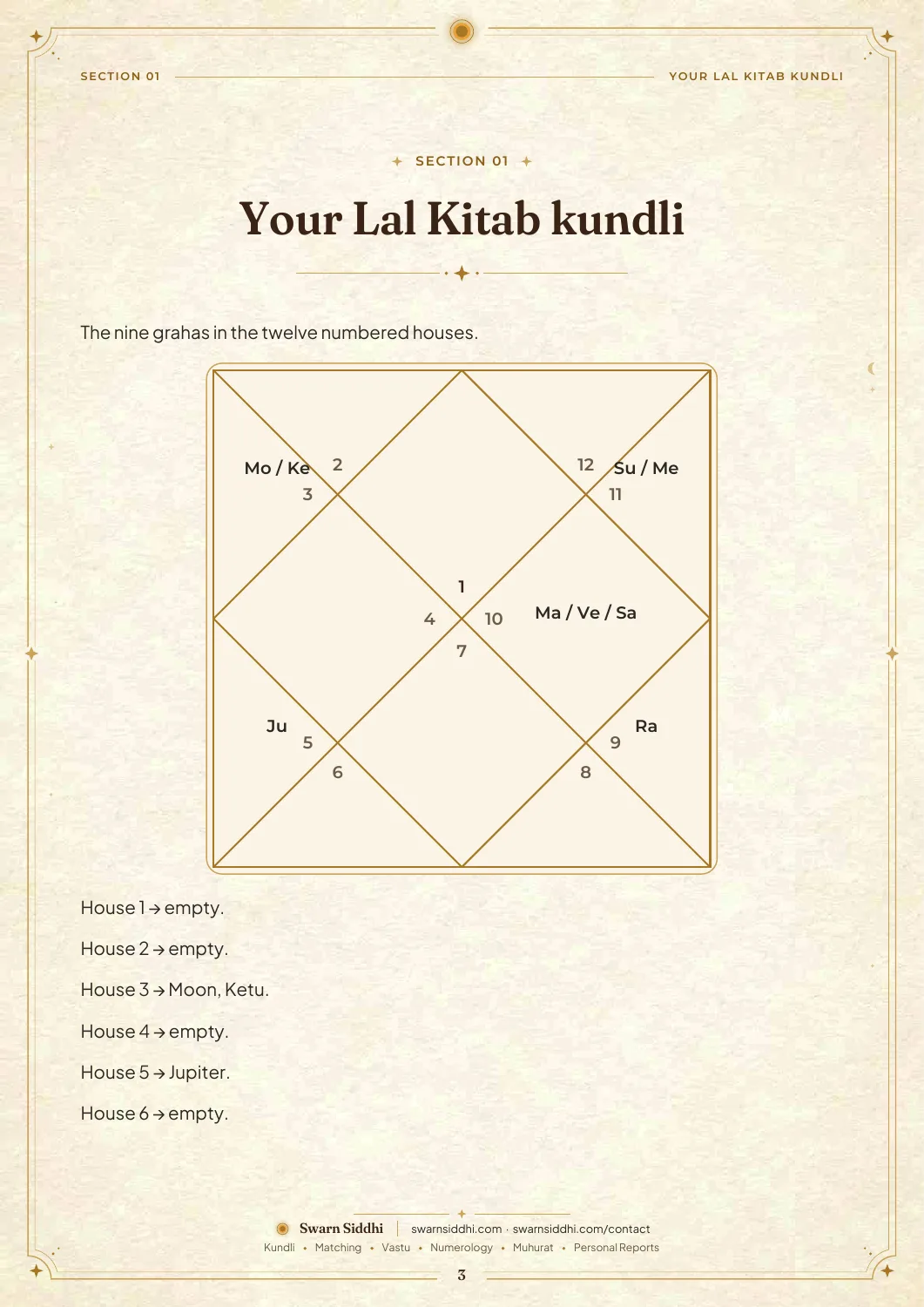
The chart puts each of the nine grahas in one of twelve fixed numbered houses. These placements are the starting facts for the later checks. The occupied houses show where to look up a placement. Empty houses can still receive sight under the stated rule.
Your Lal Kitab kundli
Lal Kitab, Tarmeem Shuda (1942), pp. 5–6
House 1 → empty.
Your Lal Kitab kundli
Lal Kitab, Tarmeem Shuda (1942), pp. 5–6
House 2 → empty.
Your Lal Kitab kundli
Lal Kitab, Tarmeem Shuda (1942), pp. 5–6
House 3 → Moon, Ketu.
Your Lal Kitab kundli
Lal Kitab, Tarmeem Shuda (1942), pp. 5–6
House 4 → empty.
05
Nine planet sutras and sleeping houses
Nine planet sutras and sleeping houses
This section reads each graha from its occupied house and compares that house with its traditional home, called pakka ghar. The sleeping label comes from the recorded sight rule. The chart can give a graha a placement reading and a separate state.
Sun
Lal Kitab placement corpus
Sun in house 11 → the traditional reading is good income from several sources.
Sun
Lal Kitab, Tarmeem Shuda (1942), pp. 47–50, 56, 62, 67
Sun in house 11 is read from the house entry with no strong placement verdict. Pakka ghar: 1. Outside its pakka ghar. Awake by the sight rule.
Moon
Lal Kitab placement corpus
Moon in house 3 → the traditional reading is creativity and short journeys.
Moon
Lal Kitab, Tarmeem Shuda (1942), pp. 47–50, 56, 62, 67
Moon in house 3 is flagged by the low-house rule or the recorded enemy contact. Pakka ghar: 4. Outside its pakka ghar. Awake by the sight rule.
06
Yuti and Lal Kitab drishti
Yuti and Lal Kitab drishti
The report records grahas in a shared house, called a yuti, and contacts between houses under the Lal Kitab sight rule. A shared house can affect each graha differently. Where the text gives a special combination, the section names the rule it used.
Yuti and Lal Kitab drishti
Lal Kitab, Tarmeem Shuda (1942), pp. 47, 56–62
Moon in house 3 and Ketu in house 3 → share a house and their effects are read together. Ketu reads this as strain. Moon reads it as strain.
Yuti and Lal Kitab drishti
Lal Kitab, Tarmeem Shuda (1942), pp. 47, 56–62
Mars in house 10 and Venus in house 10 → share a house and their effects are read together. Venus reads this as mixed. Mars reads it as mixed.
Yuti and Lal Kitab drishti
Lal Kitab, Tarmeem Shuda (1942), pp. 47, 56–62
Mars in house 10 and Saturn in house 10 → share a house and their effects are read together. Saturn reads this as strain. Mars reads it as mixed.
Yuti and Lal Kitab drishti
Lal Kitab, Tarmeem Shuda (1942), pp. 47, 56–62
Venus in house 10 and Saturn in house 10 → share a house and their effects are read together. Saturn reads this as support. Venus reads it as support.
07
Rin and ancestral themes
Rin and ancestral themes
The 1952 rin check needs both a matching root placement and corroboration from a flagged planet in house 2, 5, 9 or 12. This is a traditional chart label. Treat it as a reflection prompt and keep discussion of family members grounded in your own experience.
Rin and ancestral themes
Lal Kitab (1952), Rin ki kismein va upay, pp. 2–8
Rin is a traditional chart symbol. It gives no evidence about what any family member did.
Mercury
Lal Kitab (1952), Rin ki kismein va upay, pp. 2–8
Moon in house 3 meets the root condition for Mercury. House 9 also has a flagged planet → Behen Rin.
Saturn
Lal Kitab (1952), Rin ki kismein va upay, pp. 2–8
Sun in house 11 meets the root condition for Saturn. House 9 also has a flagged planet → Zalimana Rin.
Saturn
Lal Kitab (1952), Rin ki kismein va upay, pp. 2–8
Mars in house 10 meets the root condition for Saturn. House 9 also has a flagged planet → Zalimana Rin.
08
Your Lal Kitab remedies
Your Lal Kitab remedies
The placement readings offer practices, things to give and things to avoid. The report shows the options for the grahas selected by its remedy rules, with timing where the source gives it. The general sharing practice can stand on its own.
Your Lal Kitab remedies
Lal Kitab, Tarmeem Shuda (1942), p. 85
Work with one remedy at a time. The 1942 text gives 40–43 days for repeated personal practice and 40–43 weekly observances for a family-debt practice. Keep a stated weekday if one is given.
Your Lal Kitab remedies
Lal Kitab, Tarmeem Shuda (1942), p. 82
A general practice in the text is sharing food. Help provide a meal through a community kitchen or an animal caregiver if you already give that way.
Moon
Lal Kitab placement corpus
Moon, house 3 → Practice — Wear a silver chain · Offer white flowers at a temple.
Moon
Lal Kitab placement corpus
Moon, house 3 → Give — Rice · Camphor.
09
Remedy checklist and do’s and don’ts
Remedy checklist and do’s and don’ts
The checklist turns the previous section into an optional practice you can keep track of. Choose one action, check the timing and decide on a modest commitment. Keep donations within your means and leave shared spaces, public water and wildlife undisturbed.
Remedy checklist and do’s and don’ts
Lal Kitab, Tarmeem Shuda (1942), pp. 83–85
□ Choose one optional practice from the remedies chapter. Leave supported planets alone.
Moon
Lal Kitab placement corpus
□ One option from your chart is Moon: Wear a silver chain.
Remedy checklist and do’s and don’ts
Lal Kitab, Tarmeem Shuda (1942), p. 85
□ Keep the same time or weekday if the practice names one. Mark each day or week on your calendar.
Remedy checklist and do’s and don’ts
Practice safeguards for the source's giving and service traditions
□ Give within your means, use ordinary household materials and leave public water and wildlife undisturbed.
10
What your own Lal Kitab Report contains
- Your Lal Kitab kundliThe nine grahas in the twelve numbered houses.
- Nine planet sutras and sleeping housesThe whole placement reading for each graha, its state and its pakka ghar.
- Yuti and Lal Kitab drishtiEvery shared-house pair and recorded Lal Kitab aspect between occupied houses.
- Rin and ancestral themesThe matched debt rules, their chart evidence and traditional practices.
- Your Lal Kitab remediesPlacement-based things to do, give and avoid, with traditional timing.
- Remedy checklist and do’s and don’tsA compact reference for choosing and keeping one practice.