What does Choghadiya tell you?
Choghadiya is a traditional way to compare broad time windows within a day and night. People commonly check it when they need to begin an everyday activity but do not have a purpose-specific Muhurat. It can help answer a practical question such as, "Which available window is more suitable for starting this task?"
Each window has one of seven names: Amrit, Shubh, Labh, Chara, Udveg, Kaal or Rog. The names describe traditional qualities associated with the period. They do not predict exactly what will happen, and a supportive Choghadiya cannot remove ordinary risks, poor preparation or the need for good judgement.
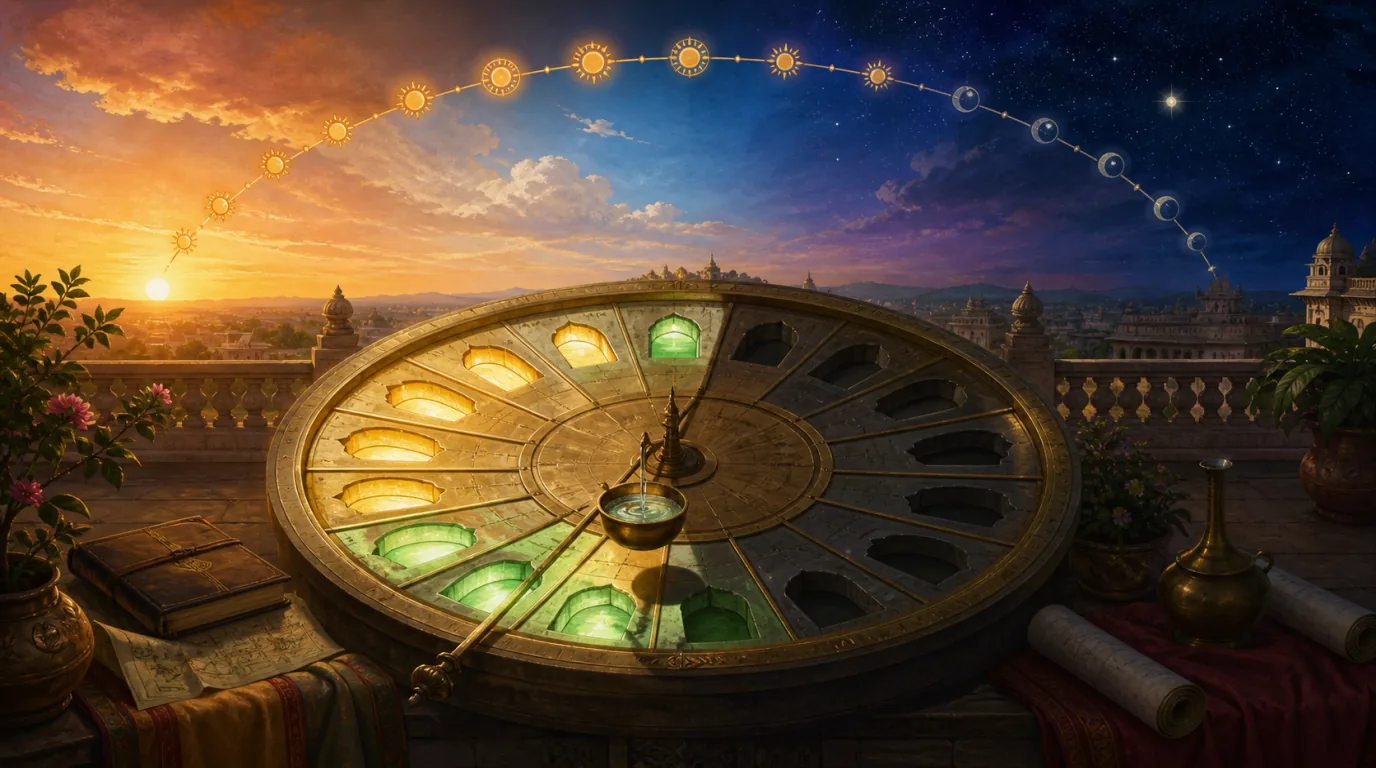
On Swarn Siddhi's Panchang, the complete schedule contains 16 periods: eight during daylight and eight during the night. This lets you compare options across the full sunrise-to-next-sunrise cycle rather than seeing only one current label.
How are the 16 periods calculated?
The time from local sunrise to local sunset is divided into eight equal parts. The time from sunset to the next local sunrise is divided separately into another eight equal parts. The weekday determines the order in which the seven Choghadiya names appear.
These are equal portions of daylight or night, not fixed clock hours. A daytime period is longer when the days are long and shorter when the days are short. Night periods change in the opposite direction. This is why a copied timetable or a claim that every Choghadiya lasts the same number of minutes can be misleading.
Location matters too. Sunrise and sunset differ between cities, even when both cities use the same time zone. Always confirm the city, date and time zone before using a schedule.
What do the seven Choghadiya names mean?
- Amrit: commonly treated as a highly supportive general window. People may prefer it for a constructive beginning, worship or an important meeting when the rest of the timing is also workable.
- Shubh: associated with auspicious or orderly activity. It is often considered for ceremonies, learning and ordinary positive beginnings.
- Labh: linked with gain and progress. It may be chosen for business discussions, purchases, applications or work intended to produce a practical benefit.
- Chara: linked with movement and change. It is commonly considered for travel, errands, communication and tasks that need flexibility.
- Udveg: associated with agitation or disruption. Many people avoid it for a calm, important beginning, while continuing work that is already under way.
- Kaal: treated as a caution period for many auspicious starts. It is not a warning that harm is certain, and it does not require normal responsibilities to stop.
- Rog: associated with strain or illness in the traditional classification. It is generally not the first choice for a celebratory or important new start.
The labels are broad filters, not a complete electional astrology reading. Traditions can also differ in how strongly they weigh a label for a particular activity.
How to use Choghadiya in five steps
- Name the activity. Be specific: leaving for a trip, signing a routine agreement and holding a wedding are very different decisions.
- Set the correct place and date. Check the local sunrise, sunset and time zone shown on the Panchang.
- Find realistic windows. Remove times when the people, office or transport you need are unavailable.
- Compare the remaining labels. Amrit, Shubh and Labh are common general choices. Chara may suit movement. Treat Udveg, Kaal and Rog as caution labels for a new auspicious start.
- Check the other timing layers. Look for Rahu Kaal and similar caution periods, then use Hora if matching the task to a planetary theme would be useful.
A simple planning example
Suppose you can begin a journey either during a Chara period or during a Rog period. Chara is traditionally associated with movement, so it would usually be the more natural choice. Before deciding, check whether that Chara period overlaps Rahu Kaal, whether the departure is practical, and whether waiting creates a real problem.
If the only workable departure falls in a caution period, this does not mean you should miss a flight or ignore a responsibility. You might use the timing as a reminder to prepare carefully rather than as a reason to fear the journey. For a major event with flexible dates, use a fuller Muhurtha assessment instead of relying on Choghadiya alone.
How Choghadiya fits with Panchang and Hora
Choghadiya is only one layer of daily timing. The five Panchang parts are Vara, Tithi, Nakshatra, Yoga and Karana. Swarn Siddhi shows the value active at local sunrise and the first exact transition before the next sunrise for the selected location. Read the plain-language Panchang guide before using those values for a precise start.
Hora divides daylight and night into planetary periods. It can help match a task with a theme, such as Mercury for writing or Saturn for patient, long-term work. Choghadiya gives a broad quality label; Hora gives a planetary emphasis. Neither layer guarantees a result.
When two layers disagree, the answer is not always to keep searching for a flawless minute. For an ordinary task, choose the clearest practical window. For a wedding, property purchase or other major commitment, a qualified practitioner may assess more factors and the charts of the people involved.
Common misunderstandings
"Amrit makes every activity successful"
No. Amrit is a traditionally supportive general label. Results still depend on the activity, the people involved, preparation and real-world conditions.
"A caution period means I must stop working"
Common practice focuses on the beginning of an important new activity. Routine work, ongoing projects and essential duties do not need to be put on hold simply because the label changes.
"Today's timings are the same everywhere"
No. The calculation starts from local sunrise and sunset. Two cities can have different clock times for every period.
Frequently asked questions
Which Choghadiya is best?
Amrit, Shubh and Labh are commonly preferred, but the best practical choice depends on the activity and other timing factors. Chara is often useful when movement or travel is central to the task.
Can I use nighttime Choghadiya?
Yes. The night has its own eight-period sequence from sunset to the next sunrise. Use it when the activity genuinely takes place at night.
Should Choghadiya control urgent decisions?
No. Do not delay emergency care, safety action or an unavoidable duty for an astrological window. Use Choghadiya as a traditional planning aid when you have a reasonable choice of start times.
Now try it on your own numbers
This guide explains the method. Open today's Choghadiya for your city to run it — the page shows its working, so you can check every step against what you have just read rather than taking the result on trust.


