What is Hora?
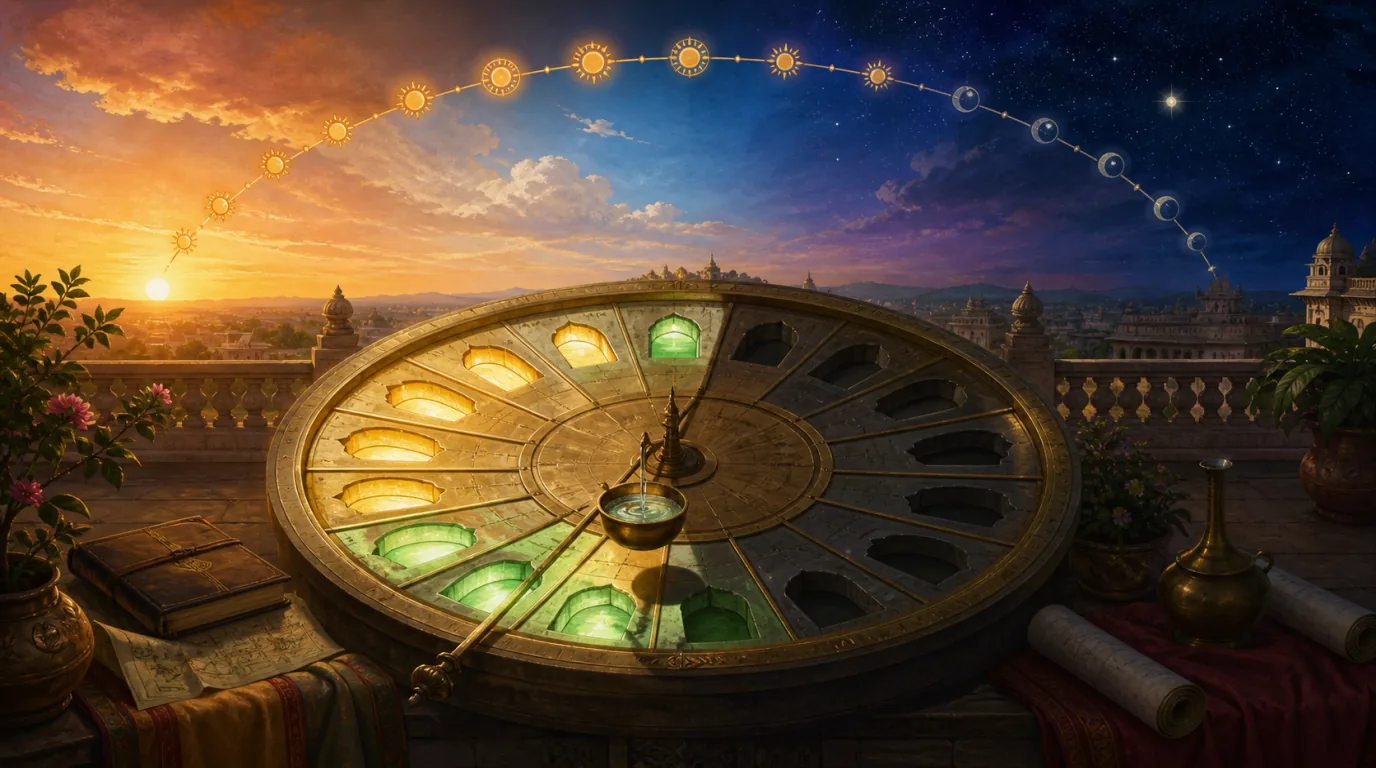
Hora is a traditional planetary-hour system used to match the timing of an activity with one of seven planetary themes. There are 24 Horas in a complete sunrise-to-next-sunrise cycle: 12 during daylight and 12 during the night.
A Hora is not necessarily a 60-minute clock hour. Its length comes from local sunrise and sunset, so it changes with location and season. The word "hour" is a useful translation, but treating every Hora as exactly 60 minutes will often produce the wrong schedule.
Hora is most useful as a practical matching tool. If you have several reasonable times for writing a proposal, for example, you might prefer a Mercury Hora. That does not guarantee acceptance; it simply follows the traditional association between Mercury and communication.
How are the 24 Horas calculated?
The period from local sunrise to local sunset is divided into 12 equal daytime Horas. The period from sunset to the next local sunrise is divided separately into 12 equal nighttime Horas. All daytime Horas on a date have the same length as each other, and all nighttime Horas have the same length as each other, but day and night lengths can differ.
The first Hora after sunrise is ruled by the planet associated with the weekday: Sun on Sunday, Moon on Monday, Mars on Tuesday, Mercury on Wednesday, Jupiter on Thursday, Venus on Friday and Saturn on Saturday.
After that, Swarn Siddhi follows this repeating order:
Sun, Venus, Mercury, Moon, Saturn, Jupiter, Mars.
The sequence continues through all 24 periods. Because of the way the seven-planet cycle repeats, the first Hora at the next sunrise belongs to the ruler of the next weekday.
Why city, date and sunrise matter
Hora begins at sunrise, not at midnight. Sunrise and sunset vary by latitude, longitude, date and time zone. A printed table based on a 6:00 AM sunrise will not remain accurate when the local Sun rises at a different time.
Season also changes the length of the periods. During a long summer day, each daytime Hora may last more than 60 minutes while the nighttime Horas are shorter. The pattern reverses when nights are longer. Check the selected city and date on the Swarn Siddhi Panchang before choosing a time.
What is each planetary Hora used for?
- Sun Hora: traditionally linked with authority, leadership, visibility and government-related work. It can be considered for presenting a decision or dealing with an official matter.
- Moon Hora: associated with home, family, care, adaptability and emotional matters. It may suit domestic planning or a thoughtful personal conversation.
- Mars Hora: linked with drive, courage, competition, exercise and decisive action. Its sharp quality may suit forceful tasks, but not every delicate negotiation.
- Mercury Hora: associated with study, writing, business, calculation, contracts and communication. It is a common choice for messages, applications and commercial discussions.
- Jupiter Hora: linked with teaching, counsel, spiritual work and long-range financial planning. It is often considered for study, guidance and constructive decisions.
- Venus Hora: associated with relationships, art, beauty, comfort and harmony. It may suit creative work, social plans or discussions that benefit from cooperation.
- Saturn Hora: linked with discipline, repairs, patient effort and long-term duties. It may fit maintenance or work that requires persistence rather than quick results.
These are broad traditional themes, not promises. The nature of the task, professional guidance and ordinary practical conditions matter more than a label. A medical decision, for example, should follow clinical need and the advice of a qualified professional, not wait for a preferred planet.
How to choose a Hora step by step
- Describe the task clearly. "Work" is too broad; writing a contract, repairing equipment and hosting a family discussion point to different themes.
- Confirm the local schedule. Set the correct city and date, then check sunrise, sunset and the complete 24-Hora list.
- Find practical options. Keep only times when the people, place and resources required for the task are available.
- Match the planetary theme. Compare the remaining Horas with the purpose of the activity.
- Check other timing factors. Note Rahu Kaal and related caution periods, and compare the broad Choghadiya quality before deciding.
A simple example
Suppose you want to send an important proposal and can do so during either a Mercury Hora or a Saturn Hora. Mercury's association with writing and business makes it the more direct traditional match. You would still proofread the proposal, confirm the recipient is available and check whether that Hora overlaps a caution period.
If the deadline falls during Saturn Hora, sending a strong proposal on time may be wiser than missing the deadline. Hora helps compare genuine choices; it should not turn a useful opportunity into an impractical delay.
How Hora fits with other timing layers
Choghadiya gives each broad period a general quality such as Amrit, Labh or Chara. Hora describes a planetary emphasis. Rahu Kaal, Yamaganda and Gulika are caution periods commonly checked before an important new beginning. These layers can overlap because they use different rules.
For ordinary planning, many people first remove a relevant caution window, then look for a supportive Choghadiya and a Hora that fits the task. A perfect match may not exist. The aim is to choose a sensible available time, not to collect every positive label.
The five parts of Panchang add further context: Vara, Tithi, Nakshatra, Yoga and Karana. Swarn Siddhi shows what is active at local sunrise and the first exact transition before the next sunrise. Check that transition before assuming a value lasts for an entire Hora. Read what Panchang means for a fuller explanation.
Common misunderstandings
"Every Hora lasts one hour"
No. The 12 daylight periods share the actual daylight span, and the 12 nighttime periods share the actual night span. Their clock duration changes.
"Jupiter or Venus Hora is best for everything"
No single planet suits every purpose. The traditional method matches the activity to the planet, while also considering other timing layers.
"A difficult Hora means the task will fail"
No. Mars and Saturn can be useful for tasks that suit their qualities, and no Hora predicts a certain outcome.
Frequently asked questions
Does Hora start at midnight?
No. The daily sequence begins at local sunrise and runs through the night until the next sunrise.
Can I use nighttime Hora?
Yes. There are 12 nighttime Horas from sunset to the next sunrise. Use them when the activity genuinely happens at night.
Is Hora enough for a wedding or major purchase?
Hora is only one filter. A major event may call for a complete Muhurtha that considers the activity, Panchang factors and, where relevant, the people involved.
Now try it on your own numbers
This guide explains the method. Open today's Hora table for your city to run it — the page shows its working, so you can check every step against what you have just read rather than taking the result on trust.